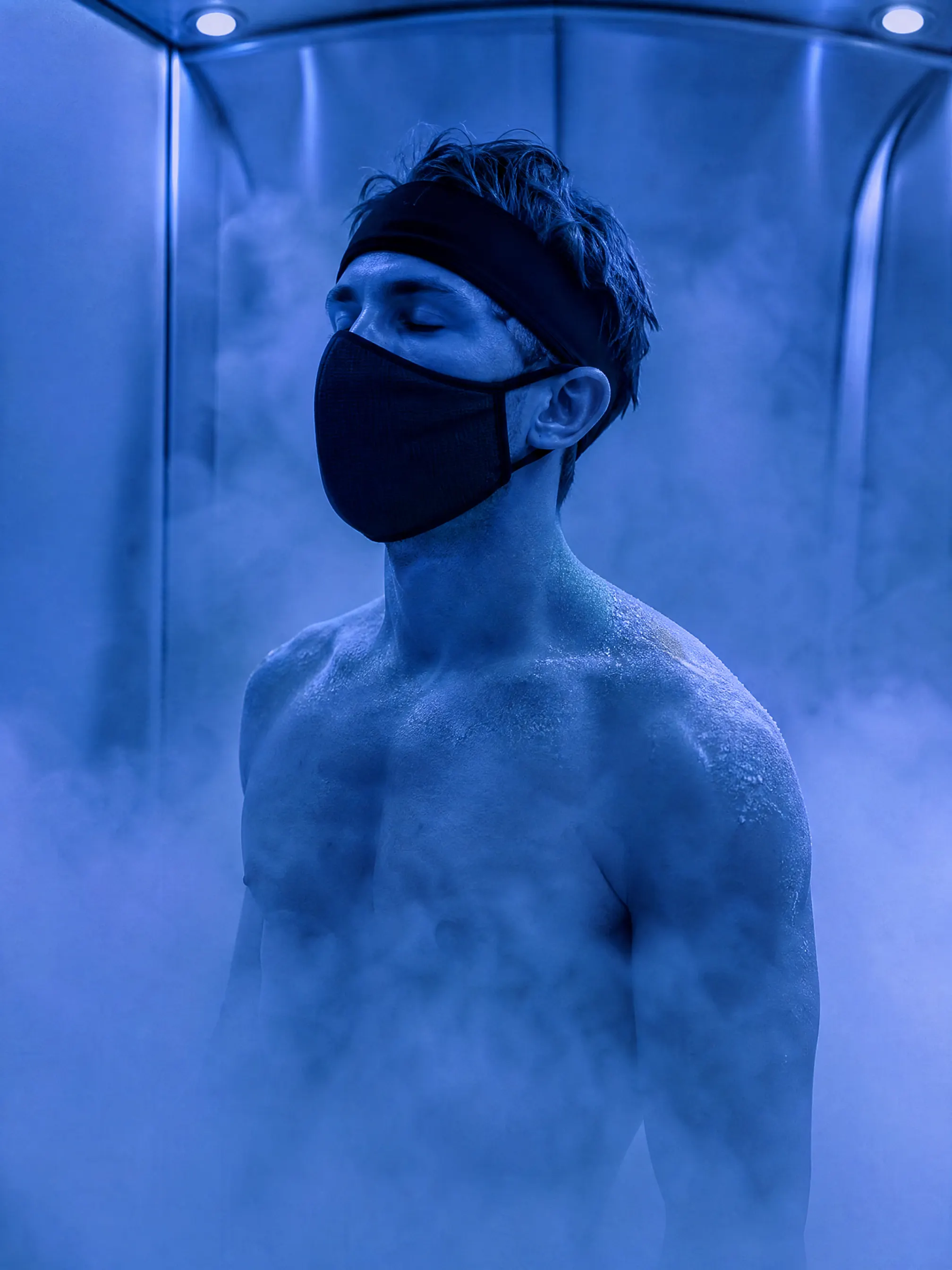
A cryotherapy chamber is an enclosed cabin that surrounds the body with very cold, dry air, usually between −85 °C and −140 °C (−121 °F to −220 °F), for two to three minutes. The cold comes either from electric refrigeration or from liquid nitrogen vapour. Businesses such as gyms, spas and recovery studios offer cryotherapy chamber sessions as part of guests’ recovery and wellness routines.
This guide explains what a cryotherapy chamber is from the operator’s side: how the machine makes cold, the main formats, what a session looks like and the vocabulary you will meet when you compare equipment.
What is a cryotherapy chamber, in plain terms
Think of it as a very cold, very dry room the size of a phone booth or a small closet. A guest wears minimal dry clothing plus gloves, socks, slippers and an ear cover, steps in, stays for two to three minutes while an operator watches, then steps out. The skin surface cools fast. Because the air holds almost no moisture, it feels very different from cold water or snow at the same temperature, and the session stays short.
The general term is whole-body cryotherapy, often shortened to WBC. In Europe you will also see cryostimulation.
How a cryotherapy chamber works
Every chamber has the same job: get the air in the cabin very cold, keep it dry and keep it stable while guests go in and out. There are two ways to do that.
Electric refrigeration
Electric chambers use a cascade refrigeration system: two or more refrigeration circuits stacked so each one cools the next, reaching far lower temperatures than a single circuit could. The cold air circulates through the cabin, and the unit removes moisture so frost does not build up. There is no liquid nitrogen on site. The guest breathes normal room air inside the chamber.
- Typical cabin air: about −85 °C to −110 °C (−121 °F to −166 °F) for walk-in chambers.
- Cold start: 45 minutes to 3 hours, depending on size. After that, the chamber stays at temperature all day.
- Running cost: electricity, typically a few hundred dollars a month or less for a single unit (about $140–200 for our X1).
Our Cryo X1 is an example: a walk-in electric chamber at −110 °C.
Liquid nitrogen vapour
Nitrogen units take liquid nitrogen from a storage tank (a dewar) and let it evaporate. The cold vapour cools the cabin. Most nitrogen units are cryosaunas, where the guest’s head stays above the rim, because breathing nitrogen vapour is dangerous: nitrogen displaces oxygen.
- Typical cabin vapour: about −120 °C to −140 °C (−184 °F to −220 °F).
- Cold start: around 10 minutes.
- Running cost: liquid nitrogen, commonly $3,000–5,000 a month at clinic volume.
- Room needs: ventilation and a wall-mounted oxygen monitor.
The full comparison, including five-year totals, is in electric vs nitrogen cryotherapy.
Types of cryotherapy chambers
| Type | Head inside? | Guests | Cooling | Typical temperature | Typical price band |
|---|---|---|---|---|---|
| Whole-body walk-in chamber | Yes | 1 | Electric | −85 to −110 °C | $65,000–100,000 |
| Multi-room / multi-guest chamber | Yes | 2–4+ | Electric (some nitrogen) | −60 °C anteroom, −110 °C main room | $150,000–280,000 |
| Cryosauna (electric) | No | 1 | Electric | around −90 °C | $25,000–30,000 |
| Cryosauna (nitrogen) | No | 1 | Liquid nitrogen | −120 to −140 °C | $20,000–35,000 (entry tier) |
| Localized device | n/a | 1 | Electric or nitrogen | cold air jet to one area | quote-based, lower cost |
Price bands are market ranges for new commercial units. See the cost guide for detail.
Whole-body walk-in chamber
The guest walks in and stands fully inside, head included. This is what most sports and recovery guests picture when they say “cryo”. Electric walk-in chambers are the most common format for gyms and recovery studios.
Multi-room chamber
Two rooms in sequence: a warmer anteroom (often about −60 °C / −76 °F) where guests acclimatise for a few seconds, then the main room at around −110 °C. These take several guests at once and suit high-volume floors.
Cryosauna
A single-guest cabin, open at the top, where the head stays in room air. A platform lifts or lowers the guest so the rim sits at shoulder height. Cryosaunas are smaller and cheaper, and they are how many first-generation studios started. They come in nitrogen and electric versions. Compare formats in cryosauna vs cryotherapy chamber.
Localized devices
Handheld or arm-mounted units that blow cold air or vapour at one area, such as a shoulder or a knee, or for cold facials. They are not chambers, but many studios offer them next to one.
What a cryotherapy chamber session looks like
From the operator’s side, a typical session runs like this:
- Screening. The guest completes a health questionnaire on the first visit. Anyone with a listed contraindication is asked to get physician clearance first. Our safety guide lists common ones.
- Changing. The guest dries off completely, removes jewellery and changes into dry shorts or underwear, plus dry gloves, socks, slippers and an ear band. Wet skin or damp clothing is the main frostbite risk.
- Briefing. The operator explains the session length, how to exit and to keep moving gently and not touch the walls.
- The session. Two to three minutes, never more than three. The operator stays at the chamber for the whole session, with eye contact or a camera and an intercom.
- Exit and warm-up. The guest steps out, dresses and warms up naturally, often with light movement.
The whole visit, including changing, usually takes 10–15 minutes. That is why a single-guest chamber serves up to about 8–10 guests an hour.
How cold is a cryotherapy chamber, and why it feels bearable
| Unit | Celsius | Fahrenheit |
|---|---|---|
| Multi-room anteroom | −60 °C | −76 °F |
| Compact electric chamber | −85 °C | −121 °F |
| Electric cryosauna | −90 °C | −130 °F |
| Electric walk-in chamber | −110 °C | −166 °F |
| Nitrogen cryosauna vapour | −120 to −140 °C | −184 to −220 °F |
Dry air conducts heat away from the skin much more slowly than water. That is why a guest can stand in −110 °C air for three minutes, while a few minutes in near-freezing water can feel harder. It is also why every chamber protocol insists on dry skin and dry clothing.
What businesses use cryotherapy chambers for
Operators add a chamber for commercial reasons: a short, repeatable service that fits memberships, sells in packages and needs one staff member per session. Common settings:
- Gyms and recovery studios, where members use cryo as part of their training and recovery routines. See chambers for gyms.
- Spas and med spas, as a quick signature service. See chambers for spas.
- Wellness and longevity centers, alongside infrared sauna, cold plunge or hyperbaric sessions. See chambers for wellness centers.
- Sports teams and hotels, for athlete or guest recovery routines.
Guests commonly pay $40–90 per session. Keep marketing to recovery and wellness language, and avoid claims that cryotherapy treats or cures any condition.
A short history of whole-body cryotherapy
Whole-body cryotherapy is usually traced to Japan in the late 1970s, where Dr. Toshima Yamauchi developed an early chamber. The idea spread to Europe in the 1980s, particularly Germany and Poland, where manufacturers and research groups built the first commercial and hospital chambers. Polish and German companies are still among the longest-running manufacturers. Cryotherapy reached the US mainstream around 2010, first with nitrogen cryosaunas, then with electric walk-in chambers as operators looked for lower running costs. Our manufacturers directory covers who builds them today.
Cryotherapy chamber glossary
| Term | Meaning |
|---|---|
| WBC | Whole-body cryotherapy. Exposing most or all of the body to very cold air. |
| PBC | Partial-body cryotherapy. Usually means a cryosauna, where the head stays out. |
| Cryostimulation | European term for whole-body cold-air exposure. |
| Cryosauna | Open-top, single-guest cabin with the head outside. Not hot like a sauna. |
| Walk-in chamber | Cabin the guest enters fully, head included. |
| Anteroom / vestibule | Warmer first room (around −60 °C) in a multi-room chamber. |
| Cascade refrigeration | Stacked refrigeration circuits used by electric chambers to reach very low temperatures. |
| LN2 | Liquid nitrogen. Boils at −196 °C (−321 °F). |
| Dewar | Insulated tank that stores liquid nitrogen on site. |
| Boil-off | Nitrogen lost to evaporation from the dewar, even when the unit is idle. |
| O₂ monitor | Sensor that alarms when oxygen in the room drops. Essential with nitrogen. |
| Localized cryotherapy | Cold air aimed at one area with a handheld or arm-mounted device. |
| Session | One cold exposure, usually two to three minutes. |
| Throughput | Guests per hour a unit can serve at full use. |
Ready to see real equipment and prices? Browse all cryotherapy chambers or read the best cryotherapy chambers guide.
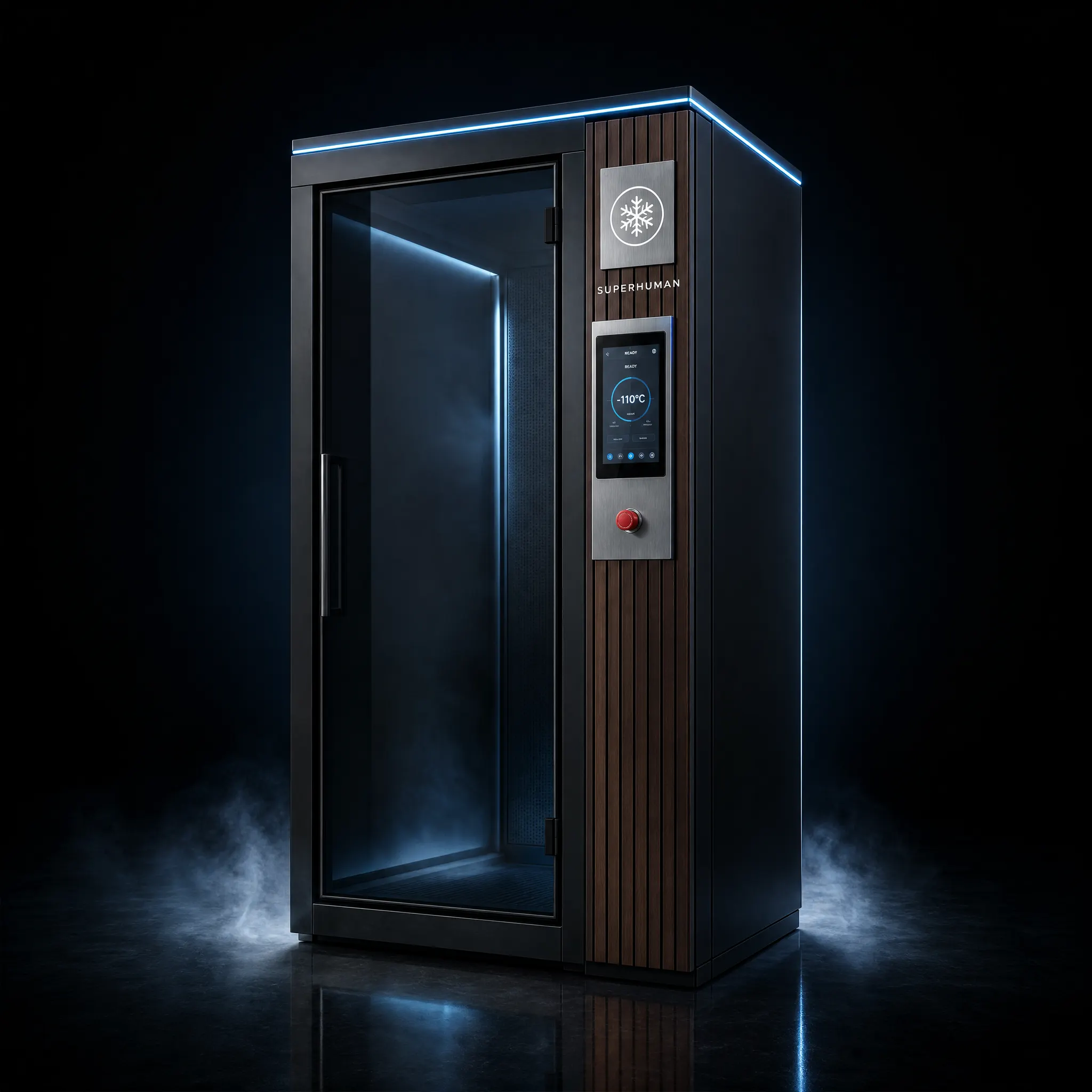
Superhuman Cryo X1
Whole-body cold, no nitrogen bill.
- Guests
- 1
- Cabin air
- −110 °C
- Cooling
- Electric
- Footprint
- 1.6 × 1.4 m