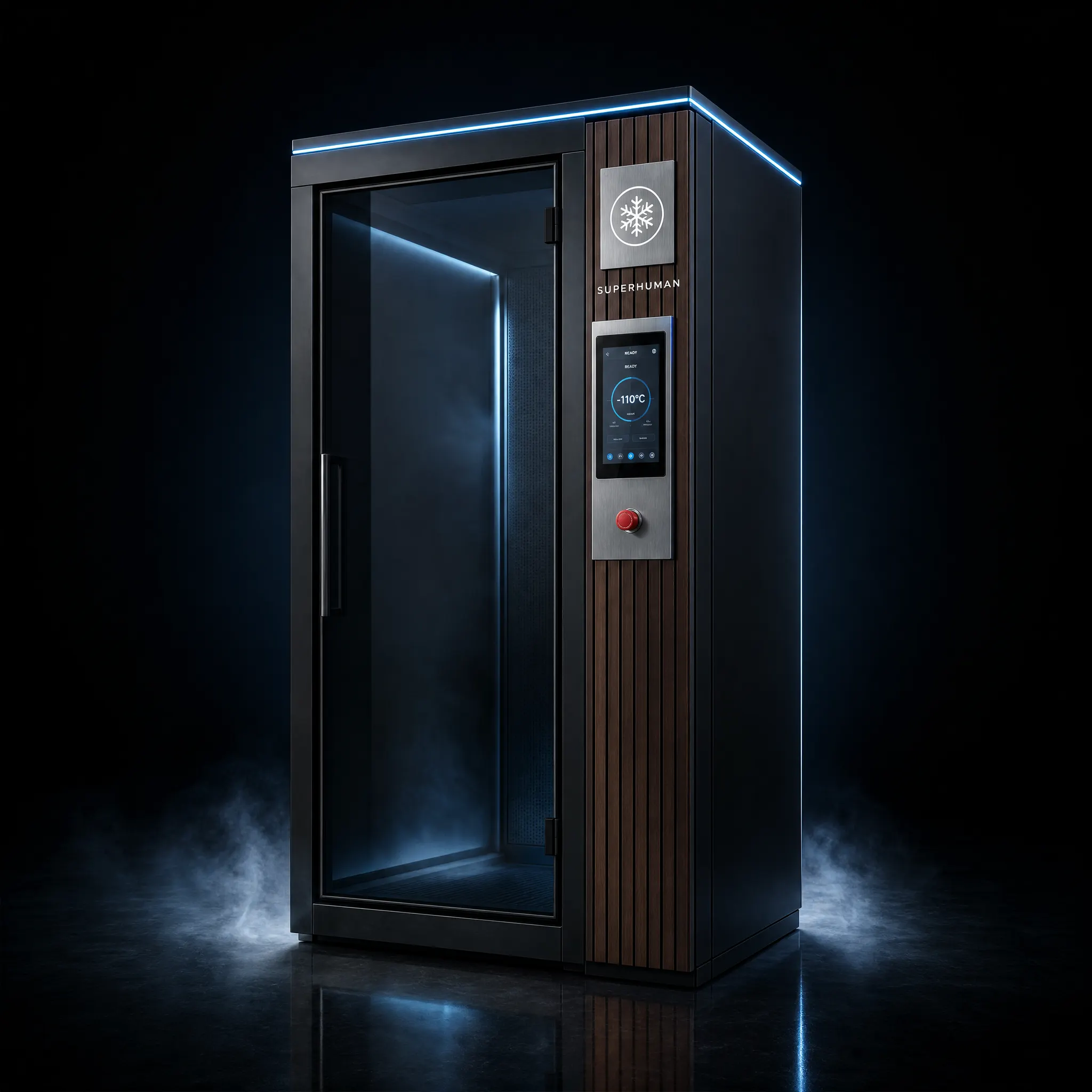
A cryotherapy chamber’s operating cost is mostly staff, space and cooling. Cooling is where the models split: a single-guest electric chamber like our Cryo X1 uses $140–200 a month in electricity, a nitrogen cryosauna uses $3,000–5,000 a month in liquid nitrogen. With staff, rent share, maintenance, consumables and insurance added, a single-guest chamber typically costs $3,500–5,000 a month to run on electric and $6,500–10,000 on nitrogen, before any lease or loan payment.
On the revenue side, operators commonly charge $40–90 per session and bring in $15,000–25,000 a month from cryo, with payback in 6–14 months. Below is how those numbers fit together, and a calculator to run your own.
Monthly operating cost: electric vs nitrogen
The table shows the costs tied directly to the unit. Staff and rent come next, because they depend on your site more than on the chamber.
| Unit | Cooling | Maintenance | Consumables* | Insurance | Direct cost / month |
|---|---|---|---|---|---|
| Cryo X1 (electric walk-in, ours) | $140–200 | $125–250 | $150–450 | $150–300 | $565–1,200 |
| Typical nitrogen cryosauna | $3,000–5,000 | $50–120 | $150–450 | $100–300 | $3,300–5,870 |
*Consumables at roughly 300–600 sessions a month on a single-guest unit. All figures are typical estimates, not quotes.
Cooling
Electric units draw power continuously to hold temperature, more during busy hours. Our figures assume typical US commercial electricity rates and a normal opening day. Nitrogen is billed by the supplier for liquid nitrogen, delivery and often dewar rental. Some nitrogen boils off in storage even on quiet days, so the bill does not fall in line with bookings. See electric vs nitrogen cryotherapy for how this compounds over five years.
Maintenance
During the warranty (2 years on the X1) parts and labour are covered. Budget for:
- Electric chambers: preventive service once or twice a year, filter and seal checks, defrost cycles. After warranty, a service plan typically runs $1,500–3,500 a year depending on model.
- Nitrogen cryosaunas: hose and valve checks, O₂ sensor calibration and periodic sensor replacement, dewar connections. Fewer moving parts, so lower maintenance, but the nitrogen bill dwarfs the saving.
Our service terms are on service and warranty.
Consumables
Guests wear dry socks, gloves, ear bands and a face mask (head-in chambers), and step into sanitised footwear. Add cleaning supplies and towels. Most operators spend $0.50–1.50 per session, and some sell branded socks and gloves at a margin.
Insurance
Equipment cover plus general and professional liability. Your insurer will ask about operating procedures and staff training. Nitrogen storage sometimes adds a rider.
Staff
Every session needs a trained operator present. In a spa or gym this is often an existing front-desk or recovery-floor role, so the real cost is a share of their hours. As a rough guide, budget $2,000–4,000 a month of staff time for a single-guest chamber running 10–20 sessions a day. Multi-guest chambers need about the same staff for more revenue per hour.
Rent share
A typical cryosauna fits in about 1.8 × 1.8 m (6 × 6 ft) of floor and an X1 in a 2 × 2 m (6.5 × 6.5 ft) room. Multi-guest suites need far more. Add a changing area. At common retail and gym rents, that share is typically $300–1,500 a month. Full room specs are in cryotherapy chamber requirements.
The revenue model
Cryo revenue comes from three places:
- Single sessions. Commonly $40–90 each. Walk-in and first-time prices sit at the higher end.
- Packs and memberships. A 10-pack or an unlimited monthly plan lowers the per-visit price but raises visit frequency and makes revenue predictable. Many operators get most of their cryo revenue from memberships.
- Bundles. Cryo added to an existing gym membership tier, a spa package or a recovery-studio plan that also includes compression, sauna or red light.
The basic formula is simple: sessions per day × average realised price × open days per month. “Average realised price” matters. If half your visits come from members on a $179 unlimited plan who visit 6 times a month, those visits are worth about $30 each, not $65.
Capacity limits. Sessions are 2–3 minutes, plus changing time. A single-guest chamber like the X1 serves up to about 8–10 guests an hour; multi-guest chambers serve more. Most single-guest operators book 15–40 sessions a day. Demand, not capacity, is usually the constraint.
Break-even and payback: worked examples
Example A: electric Cryo X1 in a gym
Assumptions: 12 sessions a day, $45 average realised price, 26 open days a month.
| Line | Monthly |
|---|---|
| Revenue (12 × $45 × 26) | $14,040 |
| Electricity | −$170 |
| Maintenance (averaged) | −$150 |
| Consumables (312 sessions × $0.80) | −$250 |
| Insurance | −$200 |
| Staff share | −$2,500 |
| Rent share | −$600 |
| Operating profit before lease | $10,170 |
| Lease payment (estimate) | −$1,450 |
| Monthly cash after lease | $8,720 |
Payback if bought outright: $69,900 ÷ $10,170 ≈ 7 months. On a lease, the chamber is cash-positive from the first month.
Break-even on a lease: fixed costs of about $5,070 a month (lease, power, maintenance, insurance, staff, rent) divided by about $44 contribution per session ≈ 115 sessions a month, or about 5 sessions a day.
Example B: a nitrogen cryosauna at the same volume
Same 12 sessions a day at $45, on a typical nitrogen cryosauna bought for about $25,000.
| Line | Monthly |
|---|---|
| Revenue | $14,040 |
| Liquid nitrogen | −$3,500 |
| Maintenance | −$100 |
| Consumables | −$250 |
| Insurance | −$200 |
| Staff share | −$2,500 |
| Rent share | −$500 |
| Operating profit before lease | $6,990 |
| Lease payment (estimate) | −$500 |
| Monthly cash after lease | $6,490 |
Payback if bought outright: $25,000 ÷ $6,990 ≈ 3.6 months. That is faster than the X1, and it is the honest reason nitrogen still sells.
Break-even on a lease: fixed costs of about $7,300 a month ÷ $44 ≈ 166 sessions, or about 7 sessions a day.
Which one earns more?
Nitrogen pays back sooner. Electric earns more every month after that. In these examples the X1 makes about $3,180 more per month in operating profit. Its roughly $45,000 higher purchase price is covered in about 14 months. Over five years, that gap is roughly $145,000 in the X1’s favour. At higher volumes the gap gets wider, because nitrogen use rises with sessions and electricity barely moves.
Example C: a membership-led studio on the X1
Assumptions: 80 members at $179 a month (about 6 visits each) plus 8 single sessions a day at $65.
- Memberships: 80 × $179 = $14,320
- Single sessions: 8 × $65 × 26 = $13,520
- Revenue ≈ $27,840 a month, about 690 sessions or 27 a day
Direct costs on the X1 of about $1,100, plus $3,000 staff, $900 rent and a $1,450 lease, leave roughly $21,000 a month. At 27 sessions a day, peak hours get busy on a single chamber, and that is the point where operators start to plan a second X1.
Run your own numbers
Enter your session price and expected bookings. The calculator uses the Cryo X1’s price and running cost from this page.
- Monthly session revenue
- —
- Cooling cost per month
- —
- Other monthly costs
- —
- Monthly profit before financing
- —
- Chamber price
- —
Estimate only, before tax and financing. Cooling cost is the model’s typical electricity or nitrogen spend.
How to lower your operating cost
- Choose electric if you expect daily volume. Past roughly 5–7 sessions a day, the nitrogen bill usually costs more than the difference in purchase price within the first year or two.
- Sell memberships, but price them on real visit frequency. Track average visits per member each month and adjust the plan price.
- Use existing staff. Cryo sits well next to a front desk or recovery floor. One operator can also run compression or red light between sessions.
- Book in blocks. Grouping sessions keeps an electric chamber at temperature efficiently, and cuts idle time for nitrogen units.
- Finance to match cash flow. A lease payment that is a fraction of monthly revenue lets the chamber pay for itself. See financing.
What not to promise guests
Whole-body cryotherapy is not FDA-cleared to treat any medical condition, and the FDA has warned about unproven health claims. Guests use it as part of recovery and wellness routines, and research on its effects is ongoing and mixed. Market cryo as a wellness service. Health claims can create legal risk that no revenue projection accounts for.
For purchase prices by tier, see cryotherapy chamber cost. For how cryo fits a fitness floor, see cryotherapy chambers for gyms.