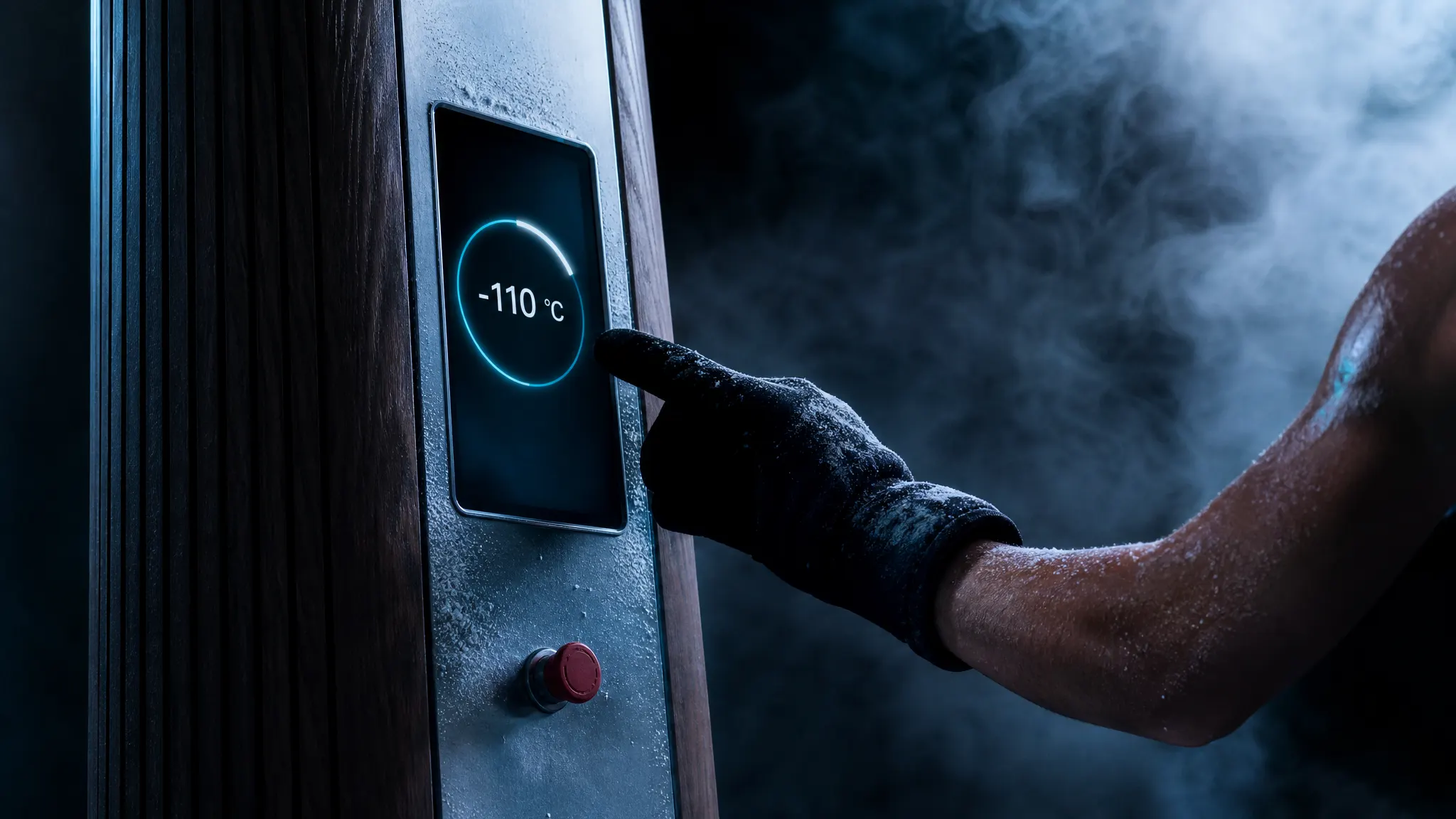
Cryotherapy chamber safety comes down to four things: screen every guest, keep skin and clothing dry, never exceed three minutes with an operator present, and, if you use liquid nitrogen, ventilate the room and monitor oxygen. The serious incidents on record involve breaking one of those rules. This guide covers each risk, the protocol that controls it and the equipment features to insist on when you buy.
The main cryotherapy chamber risks
Frostbite and cold burns
The most common injury. Dry air at −110 °C (−166 °F) is tolerable for two to three minutes because it pulls heat from the skin slowly. Water changes that. Sweat, lotion, a damp towel, wet socks or damp underwear conduct cold straight to the skin and can cause cold burns in seconds. Hands, feet and ears are most exposed, which is why gloves, socks and an ear cover are standard. Sessions that run over time increase the risk.
Low oxygen with nitrogen systems
Liquid nitrogen expands into a large volume of gas as it evaporates and pushes oxygen out of the air around it. Nitrogen has no smell or colour, so a person does not notice low oxygen before losing consciousness. The risk is highest when:
- a guest’s head drops below the rim of a nitrogen cryosauna,
- someone uses a unit alone, without an operator,
- the room is small or poorly ventilated,
- the dewar or lines leak.
In October 2015, a 24-year-old spa employee in the Las Vegas area of Nevada was found dead inside a nitrogen cryotherapy chamber she had used alone after hours. The coroner ruled that she died of asphyxia due to an oxygen-poor environment. News reports said the spa was not licensed for the procedures it offered, and Nevada health officials opened a review of cryotherapy centers. Her death is the reason the rules below exist: no one uses a nitrogen unit alone, and every nitrogen room has an oxygen monitor.
Electric chambers remove this risk. There is no liquid nitrogen on site and guests breathe normal room air. See electric vs nitrogen cryotherapy.
Reactions in guests with certain conditions
Sudden cold exposure raises blood pressure and heart rate for a short time. For most healthy adults that passes quickly. For guests with some conditions it can be dangerous, which is why screening matters.
Eye injury and slips
Very cold air can irritate the eyes, and frost can make floors slippery. Keep sessions short, keep guests moving gently and keep the chamber floor dry and clear.
Guest screening and contraindications
Every guest completes a written health questionnaire before their first session, and confirms at each visit that nothing has changed. Anyone who answers yes to a listed condition is asked to get clearance from their physician before using the chamber.
Contraindications commonly listed on cryotherapy screening forms include:
- uncontrolled high blood pressure (hypertension),
- heart conditions, including heart disease, arrhythmia, a pacemaker, or a recent heart attack,
- recent stroke,
- Raynaud’s syndrome,
- cold allergy or cold urticaria,
- pregnancy,
- deep vein thrombosis or a history of blood clots,
- severe circulation problems or peripheral vascular disease,
- seizure disorders,
- acute illness or fever,
- open wounds or recent surgery,
- claustrophobia,
- under 18 without a guardian’s written consent.
This is not a complete medical list, and staff should never make medical judgements. The form is a gate: if in doubt, the guest consults a physician before a session. Keep signed forms on file.
Operator protocol for every session
We train every client’s team on this checklist during installation. Post it next to the chamber.
| Step | Rule |
|---|---|
| Screening | Signed health form on file; ask about changes at each visit |
| Dry skin | Guest towels off completely; no lotion, oil or sweat |
| Dry clothing | Dry shorts or underwear; no metal jewellery or piercings |
| Protection | Dry gloves, dry socks, slippers or clogs, ear band; face mask on request |
| Briefing | Explain session length, how to exit, not to touch walls |
| Time | Two to three minutes; three minutes is the maximum |
| Operator | Present at the chamber for the whole session, with eye contact, camera or intercom |
| Exit | Door opens from inside at all times; guest can leave whenever they want |
| Stop | Operator stops the session at any sign of distress |
| Nitrogen units | Guest’s head stays above the rim; oxygen monitor on; ventilation running |
| After hours | Chamber powered down or locked; no staff sessions alone |
Safety features to insist on
When you compare equipment, check that each unit has:
- A door that opens from inside at all times, with no lock that can trap a guest.
- An emergency stop reachable by the operator, and ideally inside the chamber.
- An operator timer that ends the session automatically.
- Oxygen monitoring. A wall-mounted O₂ monitor with an audible alarm is essential for nitrogen units. Larger electric rooms often add O₂ and CO₂ monitoring.
- Ventilation sized for the room, especially where nitrogen is stored.
- Camera and intercom for walk-in chambers where the operator cannot see the guest’s face directly.
- A height-adjustable floor in cryosaunas, so the rim sits at shoulder level and the head stays in room air.
- Session logging, so you have a record of who used the chamber and for how long.
Our Cryo X1 has a door that opens from inside at all times, an emergency stop, an O₂ monitor, an operator intercom and a touchscreen with session presets and a guest log.
Equipment standards and certifications
- Electrical safety: in the US, look for listing by a recognized testing laboratory, such as UL or ETL (Intertek). In Europe, look for CE marking.
- Medical-device status: some European chambers are certified as medical devices. In the US, no whole-body cryotherapy device is FDA-cleared to treat any condition, so do not market it as a treatment.
- Pressure and cryogenic equipment: nitrogen dewars must meet transport and pressure-vessel rules. Your gas supplier will specify storage and handling.
- Local rules: some cities and states apply business, cosmetology or health licensing to cryotherapy. Check with your local authority before opening.
Room, power and ventilation details are in our requirements guide. For how we compare manufacturers on certification and service, see the manufacturers directory.
Staff training
Every staff member who runs sessions should be trained and signed off on:
- the screening form and when to refer a guest to a physician,
- the session checklist above,
- recognising signs of distress, frostbite and low oxygen,
- using the emergency stop and getting a guest out quickly,
- nitrogen handling, dewar changes and oxygen alarms (nitrogen sites only),
- first aid and CPR, with at least one certified person on every shift,
- daily checks: door release, emergency stop, O₂ monitor test, floor dry.
Keep a training log with dates. Refresh it when staff change and at least once a year. Our training is included with every chamber, and our service team can run refreshers.
Insurance and liability
Tell your insurer you are adding cryotherapy before the first session. Many general liability policies exclude it unless it is named. Ask about:
- general liability that names cryotherapy as a covered service,
- professional liability if you are a clinic or med spa,
- equipment coverage for the chamber itself,
- what documentation the insurer wants: signed waivers, screening forms, training logs and maintenance records.
A signed waiver does not replace good practice. Insurers and courts look at whether you followed a reasonable protocol. Keep your records.
A short safety checklist for owners
- Screening form on file for every guest.
- Dry skin, dry clothing, gloves, socks, ear cover, every time.
- Three minutes maximum, operator present, door opens from inside.
- Oxygen monitor and ventilation on every nitrogen site.
- No one uses the chamber alone, including staff.
- Trained staff, logged; first aid on every shift.
- Insurer informed, cryotherapy named on the policy.
To learn how the equipment works, read what is a cryotherapy chamber. To talk through a safe setup for your site, contact us.
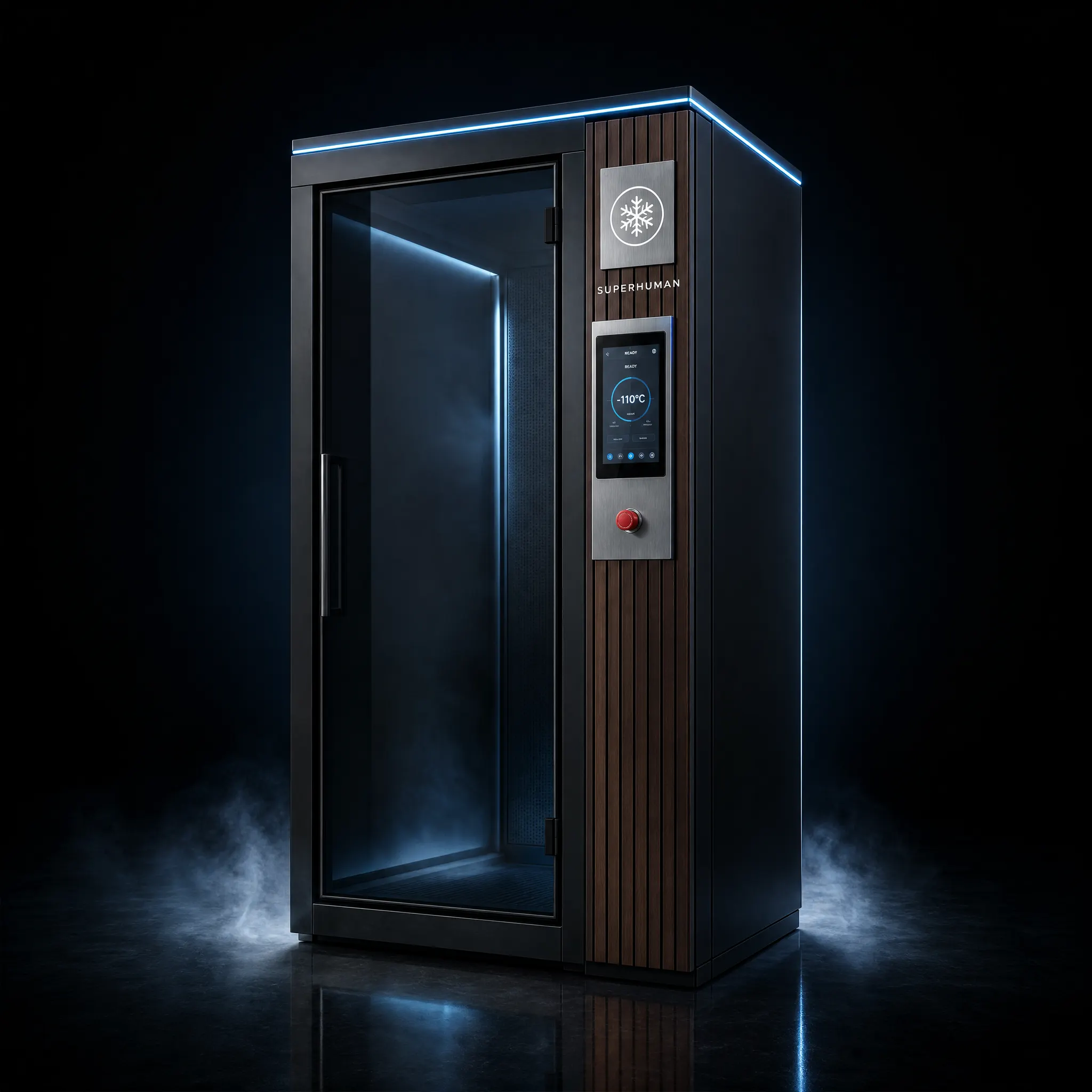
Superhuman Cryo X1
Whole-body cold, no nitrogen bill.
- Guests
- 1
- Cabin air
- −110 °C
- Cooling
- Electric
- Footprint
- 1.6 × 1.4 m