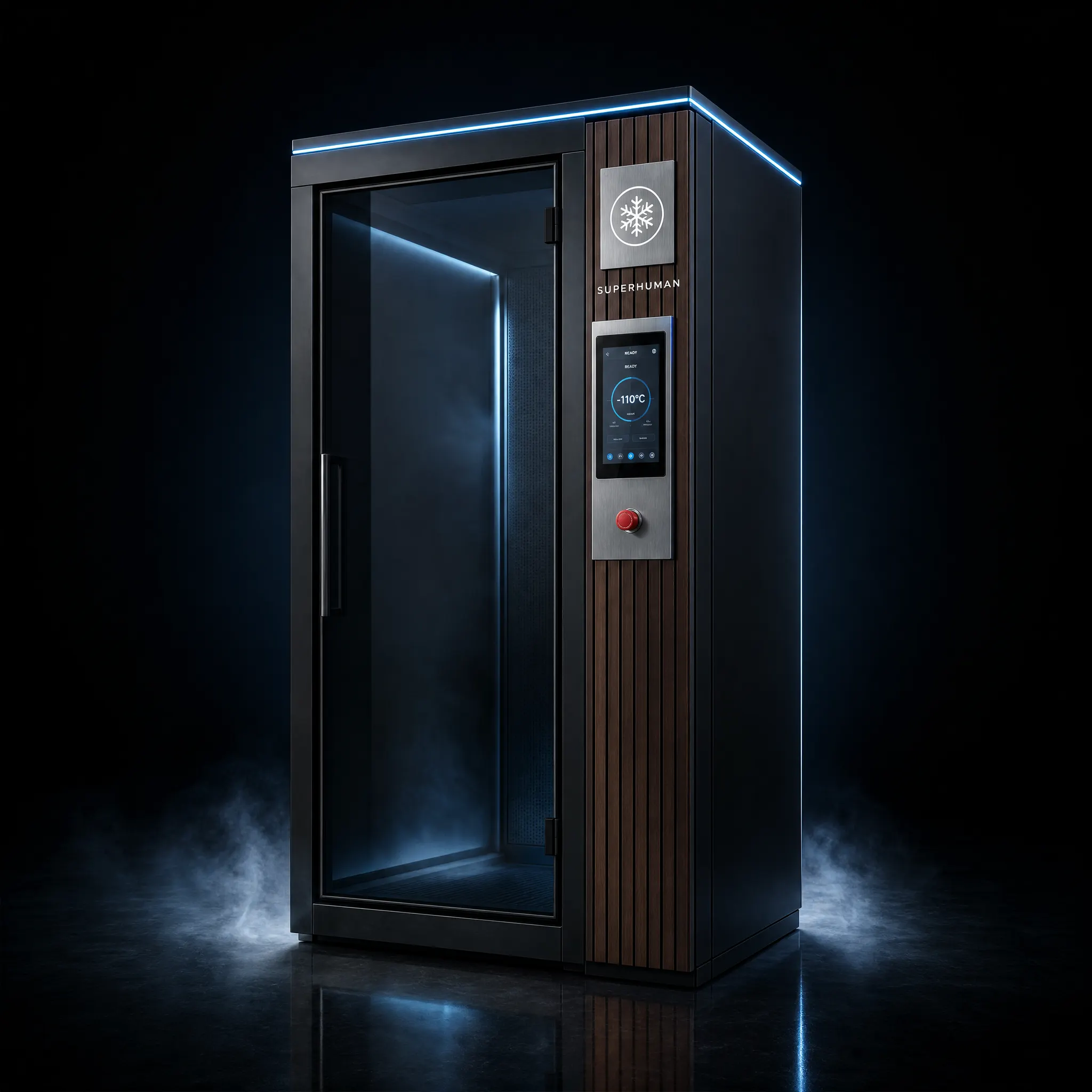
The main difference in cryosauna vs cryotherapy chamber is where the guest’s head goes. A cryosauna is a partial-body unit: the guest stands in an open-top cabin with the head above the rim. A cryotherapy chamber is a walk-in, whole-body room: the guest goes fully inside, head included. Cryosaunas cost less and fit smaller rooms. Chambers cost more, hold a stable whole-body cold, and are the format most sports and recovery buyers ask for.
We sell the walk-in Cryo X1, not a cryosauna. Here is how the two formats compare for a business.
Side-by-side comparison
| Cryosauna (head out) | Cryotherapy chamber (head in) | |
|---|---|---|
| Body coverage | Partial-body, head and neck outside | Whole-body, head inside |
| Cabin temperature | About −85 to −90 °C (−121 to −130 °F) electric; −120 to −140 °C (−184 to −220 °F) nitrogen vapour | Down to −110 °C (−166 °F) on the X1 |
| Guests per session | 1 | 1 (X1); multi-guest rooms exist |
| Throughput | Up to about 8 guests an hour | Up to 10 an hour (X1) |
| Session length | 2–3 minutes | 2–3 minutes |
| Room size | Often about 1.8 × 1.8 m (6 × 6 ft) | From 2 × 2 m (6.5 × 6.5 ft), 2.5 m ceiling |
| Power | Often single-phase (electric) or a standard outlet (nitrogen) | Dedicated three-phase circuit |
| Market price | $20,000–35,000 | $65,000–100,000 single-guest; $150,000–280,000 multi-guest |
| Our price | We do not sell one | $69,900 (X1) |
| Running cost / month | Low hundreds electric; $3,000–5,000 nitrogen | $140–200 (X1) |
Guest experience
Cryosauna: head out, face to face
In a cryosauna, the guest steps into a cylindrical cabin. A floor lift raises or lowers them so the rim sits at shoulder or neck height. The head stays in normal room air, so the guest breathes warm air and can talk face to face with the operator the whole time.
Many first-timers find this reassuring. It feels less enclosed, and there is no door closing over them. Some guests find the cold less intense on the upper body because the head, neck and sometimes shoulders are not exposed.
On a nitrogen cryosauna, guests see clouds of vapour around them. Some like the visual. On an electric cryosauna, the air is dry and clear.
Chamber: fully inside
In a walk-in chamber, the guest wears a face mask, ear band, gloves and socks, walks in and the door closes. The whole body, head included, is in dry air at around −110 °C. The operator watches through a window and stays in contact over an intercom. The door opens from inside at all times.
Guests who have used cryo before, athletes and recovery-studio regulars often ask for this format specifically, because the whole body is exposed evenly. Some larger chambers on the market add a warmer vestibule that guests pass through first, which many find gentler as an entry.
Either way, sell the experience as part of a recovery or wellness routine. Whole-body cryotherapy is not FDA-cleared to treat any medical condition, and research on its effects is ongoing and mixed. See what is a cryotherapy chamber for how sessions work.
Throughput and revenue per hour
Session length is the same, 2–3 minutes, so the difference is guests per session.
- A cryosauna serves one guest at a time. With changing and handover, that is up to about 8 guests an hour.
- A single-guest X1 chamber serves up to about 10 an hour, as guests change outside and the cabin recovers quickly.
- Multi-guest chambers serve two or more guests per session. They cost more and need more space, but multiply capacity in the same floor time.
For most single-site spas and studios, demand, not capacity, is the limit. A cryosauna or X1 comfortably handles 15–40 sessions a day. Multi-guest chambers pay off where you have peak-hour queues, group bookings (teams, couples, classes) or a membership base large enough to fill the calendar. The operating cost and ROI guide shows how throughput feeds into payback.
Space and power
| Cryosauna (typical) | Cryo X1 chamber | |
|---|---|---|
| Unit footprint | About 1.0–1.2 m square, plus a dewar for nitrogen | 1.6 × 1.4 m, 2.3 m high |
| Recommended room | About 1.8 × 1.8 m; nitrogen units need ventilation | 2.0 × 2.0 m, 2.5 m ceiling |
| Power | Single-phase (electric) or standard outlet (nitrogen) | Three-phase, dedicated circuit |
Cryosaunas fit into an existing treatment room or a corner of a recovery floor. Electric cryosaunas usually run on a single-phase circuit, which most commercial buildings already have. Nitrogen cryosaunas plug into a standard outlet but need room ventilation, an oxygen monitor and space for the nitrogen dewar. See electric vs nitrogen cryotherapy.
Chambers need a dedicated room with enough ceiling height and a three-phase supply. Larger chambers ship as modules sized for standard doorways, and we plan the access route with you. Full details are in cryotherapy chamber requirements and installation.
Price
The format drives price more than anything except cooling type.
- Cryosaunas: $20,000–35,000 across the market. See the cryosaunas buyer guide.
- Single-guest chambers: $65,000–100,000 across the market. Our X1 is $69,900 (≈$1,450/mo lease est.).
- Multi-guest chambers: $150,000–280,000 across the market.
The X1 price includes delivery, installation, commissioning and staff training in the contiguous US. Running cost matters as much as the sticker: the X1 costs $140–200 a month to run on electricity, while a nitrogen cryosauna typically costs $3,000–5,000. Full tier breakdown and hidden costs are in cryotherapy chamber cost.
Which businesses fit each format
A cryosauna fits
- Day spas and med spas adding cold therapy to a treatment menu, where guests value comfort and face-to-face contact. See cryotherapy chambers for spas.
- Boutique fitness studios with limited floor space and no three-phase supply.
- Operators testing demand before committing to a larger install.
- Low-volume or seasonal sites. For these, a nitrogen cryosauna can also make sense, with its low purchase price and quick start-up.
A chamber fits
- Gyms and recovery studios where members ask for whole-body sessions and volume is daily. See cryotherapy chambers for gyms.
- Wellness and longevity centers building cryo into memberships. See cryotherapy chambers for wellness centers.
- Sports teams, physio and sports clinics that want a head-in format for athletes.
- Hotels and destination spas that want a signature room. A multi-guest suite in the $150,000–280,000 band is the usual choice.
- Recovery franchises with peak-hour queues, where two or four guests per session protects the calendar.
How to decide
Ask three questions:
- Do your guests want head-in? If athletes and recovery regulars make up your market, choose a chamber. If your guests are mostly spa clients or first-timers, a cryosauna is often enough.
- Do you have the room and power? No three-phase supply and a small room points to a cryosauna. A dedicated room and three-phase points to the X1.
- What volume do you expect? Under a handful of sessions a day, a cryosauna keeps costs low. Daily volume favours a chamber like the X1. For group bookings at peak hours, a second X1 adds capacity.
Browse cryotherapy chambers, read our cryosaunas guide, or contact us with your floor plan and we will recommend a format.
Superhuman Cryo X1
Whole-body cold, no nitrogen bill.
- Guests
- 1
- Cabin air
- −110 °C
- Cooling
- Electric
- Footprint
- 1.6 × 1.4 m